ART OF NURSING CIC

Learning and publications

Artful Intelligence, publications, the competency framework and the webinar archive.

The human capabilities that matter

Artful Intelligence™

Nursing includes empirical, ethical, personal, aesthetic and emancipatory ways of knowing. Artful Intelligence offers a language for the human capabilities that complement artificial intelligence: aesthetic noticing, relational presence, narrative understanding, ethical imagination and creative action, the capacity to decide what knowledge means, what matters and what should happen next. The Art of Nursing Toolkit, in development for 2027, will turn the framework into practical, evaluable creative learning; collaborators are invited to pilot it. The Art of Nursing Competency Framework (Lynch 2026) integrates the arts into nursing education and practice across three levels, from foundational to advanced, and our Artful Intelligence coaching and mentoring offer supports healthcare leaders to combine clarity with compassion.

Competency Framework Coaching and Mentoring

The evolution of the idea

Artful Intelligence is Art of Nursing CIC’s account of what keeps health and care human as non-human systems take on more of the work: knowledge, judgement, creativity and radical imagination, in service of the person, the population and the planet. The idea was set out in the Journal of Research in Nursing (Lynch, 2026), is developed in the forthcoming book, and is taught in the Level 7 Artful Intelligence programme. It is now carried in five diagrams, made to one design and built in stages.

How the idea has developed

The model (October 2026). The idea was first drawn as a single framework: the four capacities at the centre, held by the society they serve, in service of the person, the population and the planet.

The creative process (November 2026). The single, crowded diagram was split into a series, each with one job. Creative thinking shows the two movements of the work: divergence, which opens up possibilities and defers judgement, and convergence, which focuses judgement and decides. Creative thinking through time places the design double diamond (after the Design Council, 2004) across four horizons of change, from tactics now to systems change beyond ten years (horizons adapted from Webb, Future Today Institute). The approach shows what it takes for good work to take root, spread and last in the real world.

Artful Intelligence™: the approach

In service of the person, the population and the planet.

Reason Approach Value People Organisation Wider system Over time

Knowledge

Judgement

Creativity

Radical imagination

The Artful Intelligence approach: seven review domains around the four capacities. Web redraw for review © Art of Nursing CIC, 2026. Domains adapted from NASSS (2017), following the PERCS layout (2021); AoN’s synthesis is proposed.

Explore the double diamond in Our work

Creative thinking across four horizons

HORIZON 01 Now

Tactics

Open up ↔ Focus

HORIZON 02 Near term

Strategy

Open up ↔ Focus

HORIZON 03 Longer term

Vision

Open up ↔ Focus

HORIZON 04 Beyond ten years

Systems change

Open up ↔ Focus

Creative thinking across four horizons of change. Horizons adapted from Webb, Future Today Institute; double diamond after Design Council (2004). Web interpretation for review © Art of Nursing CIC, 2026.

The seven domains. The approach, design double diamond and over time diagrams carry seven review domains - reason, approach, value, people, organisation, wider system, and over time - adapted from the NASSS framework (Greenhalgh and colleagues, 2017), following the layout of the PERCS framework (Greenhalgh and colleagues, 2021), which its authors themselves adapted from NASSS for remote consultations. They are lenses revisited at every movement and every horizon, not a sequence and never settled once. The Theory U diagram reads the same journey alongside these lenses; the seven domains are unchanged, not overlaid.

Everyday aesthetics (November 2026). Aesthetics was added as a proposed AoN application of Karen and Evetts (2023), writing after Dewey (1934): aesthetic appraisal is part of ordinary doing, and what people notice and feel moves them to act. In artful practice, divergence notices what stirs us; convergence applies aesthetic judgement to what matters. This is marked as a proposal - a strong conceptual warrant, not settled measurement.

Everyday aesthetics

NoticeWhat stirs us?

FeelWhat matters?

ActWhat happens next?

Everyday aesthetics: notice, feel, act. Proposed AoN application of Karen and Evetts (2023), after Dewey (1934). A conceptual warrant, not settled measurement. Web redraw for review © Art of Nursing CIC, 2026.

Theory U (November 2026). The latest addition reads the same journey through Scharmer’s Theory U (2016): five movements from co-initiating to co-evolving, with presencing at the bottom of the U - the point where open mind, open heart and open will allow an emerging future to be sensed. Its premise sits close to AoN’s own: the quality of a system’s results depends on the interior condition of the people in it, so tending the social soil comes before harvesting change. This reading already appears in Lynch’s Four Horizons - Nursing 2050 strategy piece (2026). It is offered as a proposed reading alongside creative thinking, not an equivalence of models.

A reading through Theory U

Co-initiatingListen together

Co-sensingSee the whole

PresencingOpen mind · heart · will

Co-creatingExplore the new

Co-evolvingLearn in the system

The Theory U reading, after Scharmer (2016). Proposed alongside creative thinking, rather than an equivalence of models. The seven domains remain unchanged. Web redraw for review © Art of Nursing CIC, 2026.

What is established and what is proposed

Each diagram attributes its established sources - the Design Council’s double diamond, the NASSS framework, everyday aesthetics, Theory U - and marks AoN’s own synthesis and applications as proposals for discussion, not tested models. Holding that line is part of the method: Artful Intelligence claims only what its evidence carries.

References for the framework

1. Design Council (2004). The double diamond design process model.

2. Dewey, J. (1934). Art as experience. Minton, Balch.

3. Greenhalgh, T., Wherton, J., Papoutsi, C., Lynch, J., Hughes, G., A’Court, C., Hinder, S., Fahy, N., Procter, R., & Shaw, S. (2017). Beyond adoption: a new framework for theorizing and evaluating nonadoption, abandonment, and challenges to the scale-up, spread, and sustainability of health and care technologies. Journal of Medical Internet Research, 19(11), e367.

4. Greenhalgh, T., Rosen, R., Shaw, S. E., Byng, R., Faulkner, S., Finlay, T., Grundy, E., Husain, L., Hughes, G., Leone, C., Moore, L., Papoutsi, C., Pope, C., Rybczynska-Bunt, S., Rushforth, A., Wherton, J., Wieringa, S., & Wood, G. W. (2021). Planning and evaluating remote consultation services (PERCS): a new conceptual framework incorporating complexity and practical ethics. Frontiers in Digital Health, 3,

726095.

5. Karen, K. E., & Evetts, C. L. (2023). Everyday aesthetics from an occupational perspective. Journal of Occupational Science, 30(4).

6. Lynch, M. (2026). Being human in non-human systems: why nursing leadership needs Artful Intelligence alongside artificial intelligence. Journal of Research in Nursing. doi.org/10.1177/17449871261481731

7. Lynch, M. (2026). Four Horizons - Nursing 2050 strategy piece. Art of Nursing CIC.

8. Scharmer, C. O. (2016). Theory U: Leading from the future as it emerges (2nd ed.). Berrett- Koehler.

9. Webb, A. A futurist’s framework for strategic planning. Future Today Institute / Harvard Business Review.

What is creative health?

Creative health is creative approaches and activities that have benefits for our health and wellbeing. That is the definition in the national Creative Health Review (National Centre for Creative Health, 2023): visual and performing arts, crafts, film, literature, cooking and creative activities in nature such as gardening, alongside creative approaches to health and care services, co-production, education and workforce development. It can happen in homes, communities, cultural institutions, heritage sites and healthcare settings, and contribute to preventing ill health, promoting healthy behaviours, managing long-term conditions, and treatment and recovery across the life course.

The Review’s vision is for creative health to be integral to health, social care and wider systems: person-centred and community-led, informed by lived experience, and mobilising the creative, cultural and community assets a place already has. That definition and vision are the Review’s, quoted here as the shared national language Art of Nursing works within; the outcomes of our own work are evaluated and reported separately, on the Evaluation page.

Hospital environments are part of this picture. Projects such as the Healing Walls murals at King Dinuzulu Hospital Complex in Durban, reported in South African Psychiatry (Ramlall, 2023), show how art can change the feel of a care setting - an illustration, not controlled evidence of clinical benefit. A 2021 scoping review of art in non-psychiatric hospitals found 16 studies reporting positive effects of art on well-being and behaviour (Fudickar and colleagues, 2021). The field is set out in the Arts in hospital chapter of the Routledge Handbook of Arts and Health (2025), co-authored by Dr Marion Lynch.

Read the Creative Health Review at NCCH

Ideas in print. Learning in practice.

Publications

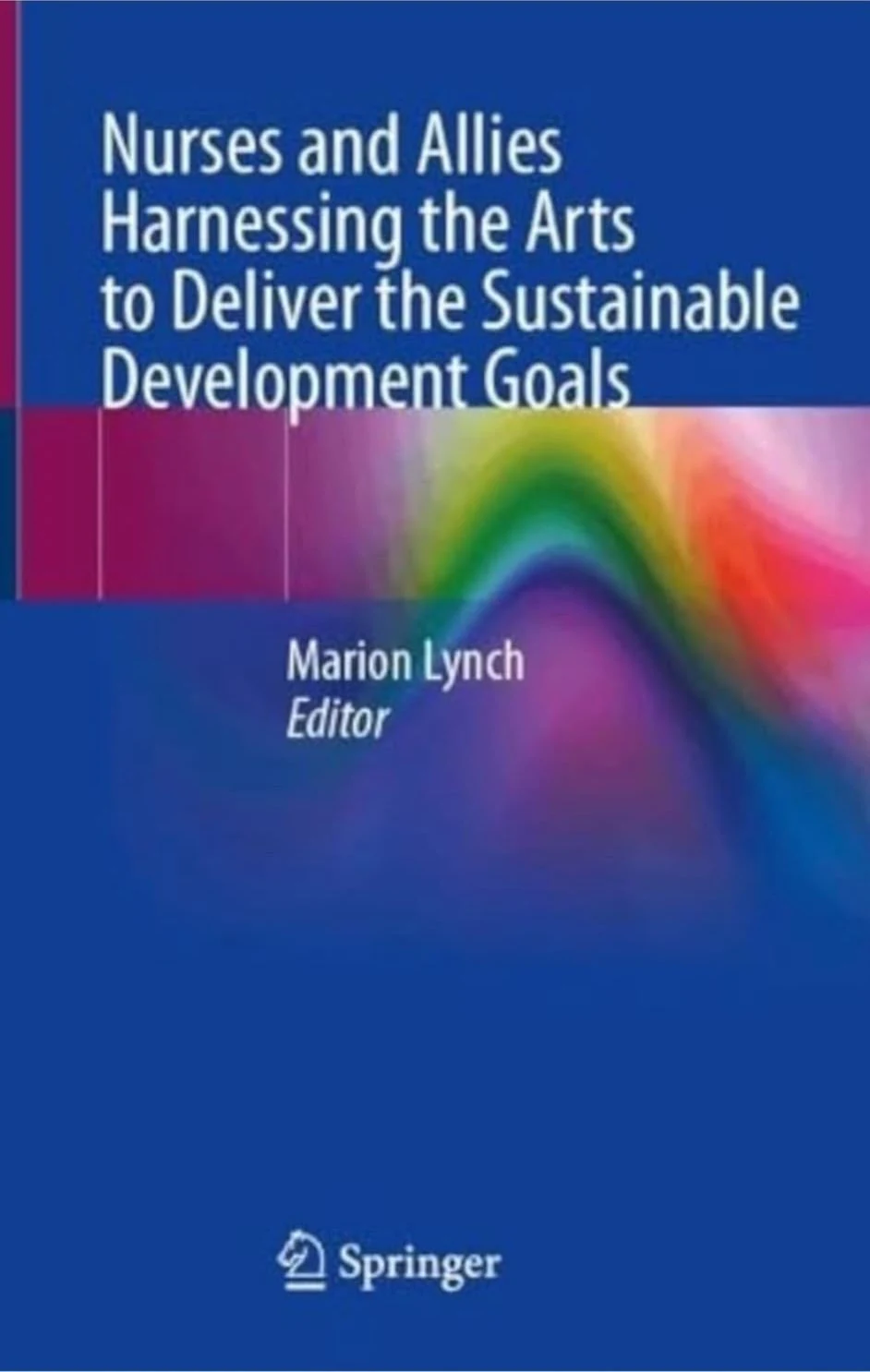
EDITED BOOK · SPRINGER · 2026

Nurses and Allies

Harnessing the Arts to Deliver the Sustainable Development Goals.

Explore the book
BOOK CHAPTER · ROUTLEDGE · 2026

Creative Health in Systems

The People, Priorities, and Challenges Shaping Integration. Edited by Jane Hearst, with the chapter “Nursing” by Marion Lynch.

Explore the Nursing chapter

All

Articles

Chapters

Evaluations

Other work

30 publications and works

Peer-reviewed articles

Lynch, M. (2026). Being human in non-human systems: why nursing leadership needs Artful Intelligence alongside artificial intelligence. Journal of Research in Nursing. doi.org/10.1177/17449871261481731 .

Peer-reviewed articles

Lynch, M. (2026). Nursing’s power problem. Nurse Education in Practice, 95, 104911. doi.org/10.1016/j.nepr.2026.104911 .

Peer-reviewed articles

Brady, L., Lynch, M., Bostock, B., & Craig, G. (2024). The case for general practice nurse-led group clinics. Practice Nurse, 54(5), 21-25. practicenurse.co.uk/articles/nursing-practice/the-case-for-general-practice-nurse-led-group-clinics .

Peer-reviewed articles

Melnikov, S., Kagan, I., Felizardo, H., Lynch, M., et al. (2022). Practices and experiences of European frontline nurses under the shadow of COVID-19. Nursing & Health Sciences. doi.org/10.1111/nhs.12936 .

Edited book

Lynch, M. (Ed.). (2026). Nurses and Allies: Harnessing the Arts to Deliver the Sustainable Development Goals. Springer. doi.org/10.1007/978-3-032-29466-1 .

Book chapters

Lynch, M. (2026). Nursing. In J. Hearst (Ed.), Creative Health in Systems (pp. 20-22). Routledge. doi.org/10.4324/9781003666424-6 .

Book chapters

Lynch, M., Trinder, L. W., Waters, L., Bruce-Gordon, S., Foster, M. W., & Sajnani, N. (2025). Arts in hospital. In Routledge Handbook of Arts and Health (pp. 310-323). Routledge. doi.org/10.4324/9781003429814-28 .

Book chapters

Lynch, M. (2026). How nursing and the arts can deliver the SDGs and shape a healthier world. In Nurses and Allies (pp. 3-12). Springer. doi.org/10.1007/978-3-032-29466-1_1 .

Book chapters

Lynch, M. (2026). Flourishing futures: nurses, artists, and allies for the SDG era 2030 and beyond. In Nurses and Allies (pp. 13-22). Springer. doi.org/10.1007/978-3-032-29466-1_2 .

Book chapters

Lynch, M. (2026). From tides to treaties: art, nursing, and the radical imagination for a sustainable future. In Nurses and Allies (pp. 23-36). Springer. doi.org/10.1007/978-3-032-29466-1_3 .

Book chapters

Lynch, M. (2026). Beauty and biology: neuroarts and how the arts affect the brain. In Nurses and Allies (pp. 37-41). Springer. doi.org/10.1007/978-3-032-29466-1_4 .

Book chapters

Lynch, M., & Poole, G. (2026). SHIFT: co-creating a play making the mental health nurses’ invisible skills visible. In Nurses and Allies (pp. 127-136). Springer. doi.org/10.1007/978-3-032-29466-1_15 .

Book chapters

Lynch, M., Enticknap, A., & Poole, G. (2026). The story of Human Story Theatre. In Nurses and Allies (pp. 195-205). Springer. doi.org/10.1007/978-3-032-29466-1_24 .

Book chapters

Lynch, M. (2026). Telling the future: radical imagination, questions to ask, answers to find. In Nurses and Allies (pp. 209-222). Springer. doi.org/10.1007/978-3-032-29466-1_25 .

Books and resources

Lynch, M. (2022). I’m Fine Project. Paintings in Hospitals, funded by the Burdett Trust for Nursing. ISBN 978-1-9162452-0-4. Bringing together the statistics, stories and images of nurses during COVID-19, to help the profession remember, reflect and recover.

Reports and evaluations

Lynch, M. (2026). Thrive Through Menopause: outcomes from realist evaluation of menopause circles supporting women’s wellbeing at work and in life. Art of Nursing CIC report for the Burdett Trust.

Reports and evaluations

Lynch, M. (2026). HeadStart evaluation, Milton Keynes. Evaluation of a large-scale arts-led drama, music and art programme with young people with health needs in Milton Keynes, for Arts for Health Milton Keynes.

Reports and evaluations

Lynch, M. (2025). Report of outcomes from co-production work reviewing the play SHIFT. Co-production with service users reviewing SHIFT for Turning Point.

Reports and evaluations

Lynch, M. (2024). Enhancing the understanding of what mental health nurses do: who are they? Final report, November 2024, for NHS England.

Reports and evaluations

Lynch, M. Evaluation of the Nursing Now Challenge Fellowship through the lens of power and gender. Art of Nursing CIC report.

Reports and evaluations

Lynch, M. (2022). Video group clinics in outpatient settings across Wales 2021-2022: evaluation report. Welsh Government.

Films and creative works

Nurses Being Seen Being Heard Being. Film creation. Cape of Home, Health, Hope. Artistic creation, now at the Royal Derby Hospital and named one of 13 UK artworks in the European CARE - Culture for Mental Health resource.

Exhibitions and creative programmes

Lynch, M. (2026) (Curator). Nurses Being Seen Being Heard Being. Exhibition presenting nursing through art. Clore Learning Centre, Kensington Palace, May 2026.

Exhibitions and creative programmes

Lynch, M. (2026). Queens and Vaccines Health Tour of Kensington Palace, connecting heritage for health, royal history, vaccination and public health, written and delivered for summit guests over three days.

Exhibitions and creative programmes

Lynch, M. New Narratives of Nursing: programme recreating collective stories of nurses’ work as prose written by nurses, developed in partnership with Smart Lark Training. Funded for nurses by Art of Nursing CIC as the social enterprise element of the CIC.

Manuscripts (not yet published)

Mwanza-Banda, Jacobs, Puta, Mutono-Mwanza, & Lynch. Beyond gender parity: women’s leadership as a gender-transformative strategy for institutionalizing quality improvement and strengthening Zambia’s health system (1991-2025). Manuscript submitted for publication. Women’s Health (SAGE), special collection.

Manuscripts (not yet published)

East, M., & Lynch, M. (2027). Midwifery in crisis? Reclaiming a global profession through decolonial practice. In C. Stringer & M. Chapman (Eds.), Decolonising Midwifery (working title).

Manuscripts (not yet published)

Craig, G., Ramdas, K., Lynch, M., Davies, E., Brady, L., Westwood, J., & Gandhi, D. Spreading group clinics at scale: insights from England and Wales. Review article manuscript (2023). Publication status to be confirmed.

Reports and evaluations

Lynch, M. (2026–2027). Evaluation of Centres of Excellence and Vanguard group clinics across Women’s Health and Primary and Community Care, with Experience Led Care. Realist mixed-methods evaluation underway.

2027 proposals

Lynch, M. Proposal submitted for a Department for Work and Pensions programme using the arts to support people returning to work, distinguishing measured employment outcomes from wider wellbeing benefits in the supporting evidence (NEETs, care leavers and women with the menopause).

Coming in 2027

60 Minutes with Sigma Phi Mu: Six Conversations Shaping the Future of Nursing

Building on the success of our evening webinars, Sigma Phi Mu Vice President Marion Lynch is working with Dan Bradshaw and Laura Potter to develop a new programme of six online events, beginning in January 2027.

The programme brings student nurses, senior leaders and partner organisations into conversation, inviting nurses to share their knowledge, experience and wisdom. Each 60-minute event will feature a student nurse, a senior nurse and a partner organisation. Together, they will examine contemporary evidence, share experience and explore ideas that could change nursing practice.

Two complementary themes connect the programme: things we know, and things to explore.

Things we know: putting evidence to work

Three conversations will examine what the evidence tells us and how nursing knowledge can improve care.

  • The Climate Crisis and Nursing: What does every nurse need to understand about climate, sustainability and health?

  • Health Inequalities: What Can Nurses Actually Change? How can nurses move beyond describing inequality to influencing its causes through practice, advocacy and population health?

  • Compassion Research That Changes Something: How do we move nursing knowledge beyond publication and into practice, policy and better outcomes?

Things to explore: imagining nursing’s future

Three conversations will explore emerging questions about artificial intelligence, future nursing roles and the shift from hospital to neighbourhood health.

  • Nursing in the Age of AI: As machines become more intelligent, what becomes more important about being human?

  • The Workforce We Haven’t Designed Yet: Are we educating nurses for the health and care system they will actually work in?

  • From Hospital to Neighbourhood: What does nursing become when more health is created beyond hospitals?

FREE TO WATCH

The webinar archive

Eleven one-hour fireside conversations, no slides, all free to watch.

All years

2024

2025

2026

The Launch (Sep 2024) Watch conversation Nursing the Planet (Nov 2024) Watch conversation Real Partnership Through Art (Jan 2025) Watch conversation Creative Health in the Curriculum (Mar 2025) Watch conversation Hearing Silent Voices (May 2025) Watch conversation Creativity, Resistance, Renewal (Jul 2025) Watch conversation Novel Nurses (Sep 2025) Watch conversation Gender Inequality (Nov 2025, RCN) Watch conversation Arts in Action (Jan 2026, RCN) Watch conversation Music and Health (Mar 2026, RCN) Watch conversation Many Different Kinds, with Michael Rosen (Apr 2026, RCN) Watch conversation

The three 2026 webinars brought total listenership to almost 2,000 with 33 contributors. Feedback told us people wanted more, so the Nursing Creative Health Special Interest Group was formed.

Writing

Longer reflections on nursing, knowledge and the human contribution to care.

ESSAY · DR MARION LYNCH

Making Visible What Matters: Professional Culture, Nursing Narrative, and Global Health

Nursing is indispensable to global health systems. It constitutes the largest health workforce globally and is central to universal health coverage and health promotion (ICN, 2025).

Read the full essay ESSAY · DR MARION LYNCH

Will Artificial Intelligence be the Anaesthetic of Nursing? Reflections using Menopause as a Case of Nursing Care

A woman sits in a clinic room, or perhaps at her desk, wondering aloud: “I think I am starting menopause and I am lost what to do.” In that moment, the response matters.

Read the full essay ESSAY · DR MARION LYNCH

Where Are the Nurses, the Women, and the Equity Lens?

Patient safety is one of the most urgent and enduring priorities in health and care for the United Kingdom in 2025. It is, in fact, the bedrock of quality healthcare.

Read the full essay ESSAY · DR MARION LYNCH

Nurses as a 21st-Century Profession: How to be Human

A nurse sits at the bedside of a patient living last days with myeloma. On one side of her chair, the monitor scrolls an endless stream of numbers, oxygen saturation, heart rate.

Read the full essay

Ideas become useful when we try them together.

Collaborate on toolkit piloting, education or mentoring.

Work with us

ART OF NURSING CIC

Learning and publications

Artful Intelligence, publications, the competency framework and the webinar archive.

Artful Intelligence™

Nursing includes empirical, ethical, personal, aesthetic and emancipatory ways of knowing. Artful Intelligence offers a language for the human capabilities that complement artificial intelligence: aesthetic noticing, relational presence, narrative understanding, ethical imagination and creative action, the capacity to decide what knowledge means, what matters and what should happen next. The Art of Nursing Toolkit, in development for 2027, will turn the framework into practical, evaluable creative learning; collaborators are invited to pilot it. The Art of Nursing Competency Framework (Lynch 2026) integrates the arts into nursing education and practice across three levels, from foundational to advanced, and our Artful Intelligence coaching and mentoring offer supports healthcare leaders to combine clarity with compassion.

The evolution of the idea

Artful Intelligence is Art of Nursing CIC’s account of what keeps health and care human as non-human systems take on more of the work: knowledge, judgement, creativity and radical imagination, in service of the person, the population and the planet. The idea was set out in the Journal of Research in Nursing (Lynch, 2026), is developed in the forthcoming book, and is taught in the Level 7 Artful Intelligence programme. It is now carried in five diagrams, made to one design and built in stages.

How the idea has developed

The model (October 2026). The idea was first drawn as a single framework: the four capacities at the centre, held by the society they serve, in service of the person, the population and the planet.

The creative process (November 2026). The single, crowded diagram was split into a series, each with one job. Creative thinking shows the two movements of the work: divergence, which opens up possibilities and defers judgement, and convergence, which focuses judgement and decides. Creative thinking through time places the design double diamond (after the Design Council, 2004) across four horizons of change, from tactics now to systems change beyond ten years (horizons adapted from Webb, Future Today Institute). The approach shows what it takes for good work to take root, spread and last in the real world.

Artful Intelligence™: the approach

In service of the person, the population and the planet.

ReasonApproachValuePeopleOrganisationWider systemOver time
Knowledge
Judgement
Creativity
Radical imagination

The Artful Intelligence approach: seven review domains around the four capacities. Web redraw for review © Art of Nursing CIC, 2026. Domains adapted from NASSS (2017), following the PERCS layout (2021); AoN’s synthesis is proposed.

Explore the double diamond in Our work

Creative thinking across four horizons

HORIZON 01Now

Tactics

Open up ↔ Focus
HORIZON 02Near term

Strategy

Open up ↔ Focus
HORIZON 03Longer term

Vision

Open up ↔ Focus
HORIZON 04Beyond ten years

Systems change

Open up ↔ Focus

Creative thinking across four horizons of change. Horizons adapted from Webb, Future Today Institute; double diamond after Design Council (2004). Web interpretation for review © Art of Nursing CIC, 2026.

The seven domains. The approach, design double diamond and over time diagrams carry seven review domains - reason, approach, value, people, organisation, wider system, and over time - adapted from the NASSS framework (Greenhalgh and colleagues, 2017), following the layout of the PERCS framework (Greenhalgh and colleagues, 2021), which its authors themselves adapted from NASSS for remote consultations. They are lenses revisited at every movement and every horizon, not a sequence and never settled once. The Theory U diagram reads the same journey alongside these lenses; the seven domains are unchanged, not overlaid.

Everyday aesthetics (November 2026). Aesthetics was added as a proposed AoN application of Karen and Evetts (2023), writing after Dewey (1934): aesthetic appraisal is part of ordinary doing, and what people notice and feel moves them to act. In artful practice, divergence notices what stirs us; convergence applies aesthetic judgement to what matters. This is marked as a proposal - a strong conceptual warrant, not settled measurement.

Everyday aesthetics

NoticeWhat stirs us?
FeelWhat matters?
ActWhat happens next?

Everyday aesthetics: notice, feel, act. Proposed AoN application of Karen and Evetts (2023), after Dewey (1934). A conceptual warrant, not settled measurement. Web redraw for review © Art of Nursing CIC, 2026.

Theory U (November 2026). The latest addition reads the same journey through Scharmer’s Theory U (2016): five movements from co-initiating to co-evolving, with presencing at the bottom of the U - the point where open mind, open heart and open will allow an emerging future to be sensed. Its premise sits close to AoN’s own: the quality of a system’s results depends on the interior condition of the people in it, so tending the social soil comes before harvesting change. This reading already appears in Lynch’s Four Horizons - Nursing 2050 strategy piece (2026). It is offered as a proposed reading alongside creative thinking, not an equivalence of models.

A reading through Theory U

Co-initiatingListen together
Co-sensingSee the whole
PresencingOpen mind · heart · will
Co-creatingExplore the new
Co-evolvingLearn in the system

The Theory U reading, after Scharmer (2016). Proposed alongside creative thinking, rather than an equivalence of models. The seven domains remain unchanged. Web redraw for review © Art of Nursing CIC, 2026.

What is established and what is proposed

Each diagram attributes its established sources - the Design Council’s double diamond, the NASSS framework, everyday aesthetics, Theory U - and marks AoN’s own synthesis and applications as proposals for discussion, not tested models. Holding that line is part of the method: Artful Intelligence claims only what its evidence carries.

References for the framework

1. Design Council (2004). The double diamond design process model.

2. Dewey, J. (1934). Art as experience. Minton, Balch.

3. Greenhalgh, T., Wherton, J., Papoutsi, C., Lynch, J., Hughes, G., A’Court, C., Hinder, S., Fahy, N., Procter, R., & Shaw, S. (2017). Beyond adoption: a new framework for theorizing and evaluating nonadoption, abandonment, and challenges to the scale-up, spread, and sustainability of health and care technologies. Journal of Medical Internet Research, 19(11), e367.

4. Greenhalgh, T., Rosen, R., Shaw, S. E., Byng, R., Faulkner, S., Finlay, T., Grundy, E., Husain, L., Hughes, G., Leone, C., Moore, L., Papoutsi, C., Pope, C., Rybczynska-Bunt, S., Rushforth, A., Wherton, J., Wieringa, S., & Wood, G. W. (2021). Planning and evaluating remote consultation services (PERCS): a new conceptual framework incorporating complexity and practical ethics. Frontiers in Digital Health, 3,

726095.

5. Karen, K. E., & Evetts, C. L. (2023). Everyday aesthetics from an occupational perspective. Journal of Occupational Science, 30(4).

6. Lynch, M. (2026). Being human in non-human systems: why nursing leadership needs Artful Intelligence alongside artificial intelligence. Journal of Research in Nursing. doi.org/10.1177/17449871261481731

7. Lynch, M. (2026). Four Horizons - Nursing 2050 strategy piece. Art of Nursing CIC.

8. Scharmer, C. O. (2016). Theory U: Leading from the future as it emerges (2nd ed.). Berrett- Koehler.

9. Webb, A. A futurist’s framework for strategic planning. Future Today Institute / Harvard Business Review.

What is creative health?

Creative health is creative approaches and activities that have benefits for our health and wellbeing. That is the definition in the national Creative Health Review (National Centre for Creative Health, 2023): visual and performing arts, crafts, film, literature, cooking and creative activities in nature such as gardening, alongside creative approaches to health and care services, co-production, education and workforce development. It can happen in homes, communities, cultural institutions, heritage sites and healthcare settings, and contribute to preventing ill health, promoting healthy behaviours, managing long-term conditions, and treatment and recovery across the life course.

The Review’s vision is for creative health to be integral to health, social care and wider systems: person-centred and community-led, informed by lived experience, and mobilising the creative, cultural and community assets a place already has. That definition and vision are the Review’s, quoted here as the shared national language Art of Nursing works within; the outcomes of our own work are evaluated and reported separately, on the Evaluation page.

Hospital environments are part of this picture. Projects such as the Healing Walls murals at King Dinuzulu Hospital Complex in Durban, reported in South African Psychiatry (Ramlall, 2023), show how art can change the feel of a care setting - an illustration, not controlled evidence of clinical benefit. A 2021 scoping review of art in non-psychiatric hospitals found 16 studies reporting positive effects of art on well-being and behaviour (Fudickar and colleagues, 2021). The field is set out in the Arts in hospital chapter of the Routledge Handbook of Arts and Health (2025), co-authored by Dr Marion Lynch.

Read the Creative Health Review at NCCH

Publications

Nurses and Allies: Harnessing the Arts to Deliver the Sustainable Development Goals book cover
EDITED BOOK · SPRINGER · 2026

Nurses and Allies

Harnessing the Arts to Deliver the Sustainable Development Goals.

Explore the book
Creative Health in Systems: The People, Priorities, and Challenges Shaping Integration, edited by Jane Hearst
BOOK CHAPTER · ROUTLEDGE · 2026

Creative Health in Systems

The People, Priorities, and Challenges Shaping Integration. Edited by Jane Hearst, with the chapter “Nursing” by Marion Lynch.

Explore the Nursing chapter
Filter publications

Publications and works

Peer-reviewed articles

Lynch, M. (2026). Being human in non-human systems: why nursing leadership needs Artful Intelligence alongside artificial intelligence. Journal of Research in Nursing. doi.org/10.1177/17449871261481731.

Peer-reviewed articles

Melnikov, S., Kagan, I., Felizardo, H., Lynch, M., et al. (2022). Practices and experiences of European frontline nurses under the shadow of COVID-19. Nursing & Health Sciences. doi.org/10.1111/nhs.12936.

Edited book

Lynch, M. (Ed.). (2026). Nurses and Allies: Harnessing the Arts to Deliver the Sustainable Development Goals. Springer. doi.org/10.1007/978-3-032-29466-1.

Book chapters

Lynch, M., Trinder, L. W., Waters, L., Bruce-Gordon, S., Foster, M. W., & Sajnani, N. (2025). Arts in hospital. In Routledge Handbook of Arts and Health (pp. 310-323). Routledge. doi.org/10.4324/9781003429814-28.

Book chapters

Lynch, M. (2026). How nursing and the arts can deliver the SDGs and shape a healthier world. In Nurses and Allies (pp. 3-12). Springer. doi.org/10.1007/978-3-032-29466-1_1.

Book chapters

Lynch, M. (2026). Flourishing futures: nurses, artists, and allies for the SDG era 2030 and beyond. In Nurses and Allies (pp. 13-22). Springer. doi.org/10.1007/978-3-032-29466-1_2.

Book chapters

Lynch, M. (2026). From tides to treaties: art, nursing, and the radical imagination for a sustainable future. In Nurses and Allies (pp. 23-36). Springer. doi.org/10.1007/978-3-032-29466-1_3.

Book chapters

Lynch, M. (2026). Beauty and biology: neuroarts and how the arts affect the brain. In Nurses and Allies (pp. 37-41). Springer. doi.org/10.1007/978-3-032-29466-1_4.

Book chapters

Lynch, M., & Poole, G. (2026). SHIFT: co-creating a play making the mental health nurses’ invisible skills visible. In Nurses and Allies (pp. 127-136). Springer. doi.org/10.1007/978-3-032-29466-1_15.

Book chapters

Lynch, M. (2026). Telling the future: radical imagination, questions to ask, answers to find. In Nurses and Allies (pp. 209-222). Springer. doi.org/10.1007/978-3-032-29466-1_25.

Books and resources

Lynch, M. (2022). I’m Fine Project. Paintings in Hospitals, funded by the Burdett Trust for Nursing. ISBN 978-1-9162452-0-4. Bringing together the statistics, stories and images of nurses during COVID-19, to help the profession remember, reflect and recover.

Reports and evaluations

Lynch, M. (2026). Thrive Through Menopause: outcomes from realist evaluation of menopause circles supporting women’s wellbeing at work and in life. Art of Nursing CIC report for the Burdett Trust.

Reports and evaluations

Lynch, M. (2026). HeadStart evaluation, Milton Keynes. Evaluation of a large-scale arts-led drama, music and art programme with young people with health needs in Milton Keynes, for Arts for Health Milton Keynes.

Reports and evaluations

Lynch, M. (2025). Report of outcomes from co-production work reviewing the play SHIFT. Co-production with service users reviewing SHIFT for Turning Point.

Reports and evaluations

Lynch, M. (2024). Enhancing the understanding of what mental health nurses do: who are they? Final report, November 2024, for NHS England.

Reports and evaluations

Lynch, M. Evaluation of the Nursing Now Challenge Fellowship through the lens of power and gender. Art of Nursing CIC report.

Reports and evaluations

Lynch, M. (2022). Video group clinics in outpatient settings across Wales 2021-2022: evaluation report. Welsh Government.

Films and creative works

Nurses Being Seen Being Heard Being. Film creation. Cape of Home, Health, Hope. Artistic creation, now at the Royal Derby Hospital and named one of 13 UK artworks in the European CARE - Culture for Mental Health resource.

Exhibitions and creative programmes

Lynch, M. (2026) (Curator). Nurses Being Seen Being Heard Being. Exhibition presenting nursing through art. Clore Learning Centre, Kensington Palace, May 2026.

Exhibitions and creative programmes

Lynch, M. (2026). Queens and Vaccines Health Tour of Kensington Palace, connecting heritage for health, royal history, vaccination and public health, written and delivered for summit guests over three days.

Exhibitions and creative programmes

Lynch, M. New Narratives of Nursing: programme recreating collective stories of nurses’ work as prose written by nurses, developed in partnership with Smart Lark Training. Funded for nurses by Art of Nursing CIC as the social enterprise element of the CIC.

Manuscripts (not yet published)

Mwanza-Banda, Jacobs, Puta, Mutono-Mwanza, & Lynch. Beyond gender parity: women’s leadership as a gender-transformative strategy for institutionalizing quality improvement and strengthening Zambia’s health system (1991-2025). Manuscript submitted for publication. Women’s Health (SAGE), special collection.

Manuscripts (not yet published)

East, M., & Lynch, M. (2027). Midwifery in crisis? Reclaiming a global profession through decolonial practice. In C. Stringer & M. Chapman (Eds.), Decolonising Midwifery (working title).

Manuscripts (not yet published)

Craig, G., Ramdas, K., Lynch, M., Davies, E., Brady, L., Westwood, J., & Gandhi, D. Spreading group clinics at scale: insights from England and Wales. Review article manuscript (2023). Publication status to be confirmed.

Reports and evaluations

Lynch, M. (2026–2027). Evaluation of Centres of Excellence and Vanguard group clinics across Women’s Health and Primary and Community Care, with Experience Led Care. Realist mixed-methods evaluation underway.

2027 proposals

Lynch, M. Proposal submitted for a Department for Work and Pensions programme using the arts to support people returning to work, distinguishing measured employment outcomes from wider wellbeing benefits in the supporting evidence (NEETs, care leavers and women with the menopause).

Coming in 2027

60 Minutes with Sigma Phi Mu: Six Conversations Shaping the Future of Nursing

Building on the success of our evening webinars, Sigma Phi Mu Vice President Marion Lynch is working with Dan Bradshaw and Laura Potter to develop a new programme of six online events, beginning in January 2027.

The programme brings student nurses, senior leaders and partner organisations into conversation, inviting nurses to share their knowledge, experience and wisdom. Each 60-minute event will feature a student nurse, a senior nurse and a partner organisation. Together, they will examine contemporary evidence, share experience and explore ideas that could change nursing practice.

Two complementary themes connect the programme: things we know, and things to explore.

Things we know: putting evidence to work

Three conversations will examine what the evidence tells us and how nursing knowledge can improve care.

  • The Climate Crisis and Nursing: What does every nurse need to understand about climate, sustainability and health?
  • Health Inequalities: What Can Nurses Actually Change? How can nurses move beyond describing inequality to influencing its causes through practice, advocacy and population health?
  • Compassion Research That Changes Something: How do we move nursing knowledge beyond publication and into practice, policy and better outcomes?

Things to explore: imagining nursing’s future

Three conversations will explore emerging questions about artificial intelligence, future nursing roles and the shift from hospital to neighbourhood health.

  • Nursing in the Age of AI: As machines become more intelligent, what becomes more important about being human?
  • The Workforce We Haven’t Designed Yet: Are we educating nurses for the health and care system they will actually work in?
  • From Hospital to Neighbourhood: What does nursing become when more health is created beyond hospitals?

Ideas become useful when we try them together.

Collaborate on toolkit piloting, education or mentoring.

Work with us