Looking for a way to share your work in a way others will read?
What if you could publish your project or research in a collection of publicly available short stories?
Art of Nursing CIC, Smart Lark Training and Ruler’s Wit have joined together as a team of nurses, researchers, educators, writers, copywriters, designers and editors to transform complex ideas into compelling, creative work.
Our approach blends nursing care, nursing expertise and storytelling craft with a deep understanding of research communication.
We help people find creative engaging ways to share their work and making nursing seen.
Through creative sessions participants will rework their own research into short, engaging stories.
Using techniques from fiction and narrative writing like character, structure and dialogue we help nurses, researchers and creative health leaders bring their ideas to life in ways that resonate far beyond academic audiences.
This is a hands-on, experimental process developing a completely different way of thinking about research communication.
All participants will have the rare opportunity to see their work brought together in a professionally produced collection, our working title is New Narratives of Nursing.
Through a unique workshop focused on turning your research into a short story you will have the opportunity to be professionally curated and published as part of real anthology.
This is more than gaining a new creative skill; it’s creating something tangible and shareable, extending nursing knowledge far beyond traditional ways of seeing nursing.
Starting with a morning working with the writers and editors (9.00-12.00) on Saturday 12th September 2026 with a publication date of May 2027 and in bookshops by then too.
Contact drmarionlynch@gmail.com with Narrativies of Nursing in email query to express interest or find out more.
Spaces on workshop limited to 40, chapter authors limited to 20. SmartLark writers will help this process so the quality of work is excellent.
Our film about nurses’ health has been added to the Burdett film hub. Developed with Human Story Theatre and C3 in response to a request to address nurses’ health and weight, this contensious issue was explored and our film made.
Through interviews with nurses we found out that they expected to have to go up a dress size whilst training, and they did.
Nursing artifacts are becoming a work of art.
The Cape of Home. Health. Hope.
This artwork be part of the Nurses: Being Seen. Being Heard. Being. Exhibition in May, and then become part of the entrance to Derby Hospital.
Cape of Home, Health Hope carries one family’s nursing story across four generations, from 1926 to 2026. It is a story of women’s migration, of lives, sometimes lived a long way from home. It is symbol of hope and a way to wonder what the next generations of nurses will do.
This is the story of the Cape of Home, Health, Hope.
Words and images really matter. My current work in nursing and public health is more about designing public health interventions and developing people rather than working with a diagnosis and sorting symptoms of disease. But I started as many nurses do, out of my depth, in trouble and wondering if this career really was for me. And then I read a poem.
My world of the arts in nursing started in the 1980’s when as a 21 year old in my first staff nurse post. Warded by buckle of power and so in charge of a ward and the people and activities within in. I was on the Heamatology ward, level seven, John Radcliffe Hospital, Oxford. I was looking after young men with Leukaemia. I quickly realised I was not at all prepared for the weight of life and death I was being trusted with. It was the time of some radicals in nursing, but they were few and far between. I was still in a hat and a buckle, american tan coloured tights and a dark blue registered nurse belt signalling I was the one to ask.
I did read what was seen as a radical book. The Politics of Nursing. And there at the beginning of this book was a poem that summed up all by unformed ideas, unthinkable thoughts and invisible (then) views of what the future of nursing could be. And it changed my path; pushed me from general nursing into training to be a mental health nurse. I knew there was more to nursing than I could see, and then people expected me to be. It was this poem that clarified it and started forty more years in health and the arts.
He came on to the ward at ten
I was right, he said.
leukaemia
I said he’d got leukaemia, didn’t I?
Are the parents here?
Nurse-go and see.
She went, running.
Yes, they’re here, she said, breathlessly
I’ll break it to them, he said
decisively
and broke them
And left the nurse with the pieces,
But she wasn’t trained to cope with broken lives
She was only trained
to fetch the stethoscope.
Mary Twomey. District Nurse.
The skills and theories for this human part of nursing have been my 40 year mission. Such skills to connect to the human aspect of people are not unique to nursing. They are used in the arts to create connection and presence, and to develop social movements in public health too. These three intertwining elements have therefore made up my nursing life.
Within nursing, this human aspect of nursing I have termed artful intelligence™. This intelligence is made up of many parts and is needed not just to pick up broken lives but because people really need to trust you and what you say if they are going to change their minds, behaviours or just listen. This is true whether working with one person or at a population level to improve systems for health, The arts create stories and connections that change minds and save lives.
Such approaches are also called public narrative approaches, and they are built upon the knowledge that transformation of any kind begins when personal experience is connected to a collective identity and an urgent purpose requiring action (Ganz, 2010). In other words, people will connect and care. This is why I have created the cape, to show nursing in a light that policies cannot.
This Cape is designed to connect to the public and to communities of nurses. It begins in 1926, and the lives of two sisters from County Kerry, Ita and May. Ita was my grandmother and May my great aunt. They became nurses, one came to nurse in London during World War Two, then returned to Ireland when she was bombed out of her nursing quarters. Both then migrated to Derby in the 1950s. This family story moves through Ita’s daughters, my aunts Marie and Anne, also nurses, who, in the 1950s also travelled from Ireland to Derby and in the 1960’s to Newfoundland and Hong Kong, returning to Derby to have families and nurse some more. The extended family included more nursing aunts, Nancy and Maggie, marrying into my expanding Irish from the 1970s onwards. The third generation is me, Marion, a 1980’nurse working globally and again coming back to the UK, now working in the arts to improve health. And then the cape goes to the 21st century, to the fourth generation, Ita’s great granddaughters, Nellie and Emily, nurses educated in Nottingham and Derby, working in the NHS, in Rwanda, and now having families of their own.
All are adventurous women, women with amazing strength of character and the skills needed to be amazing nurses too, to innovate and do what others are not brave enough to do. Go first, leave home, speak up and stand out. 100 years of women surviving illness, bombs, three weeks crossing the Atlantic to nurse in a new country knowing no one, again. Women with the ability and humility to work with Chinese communities in China, Aboriginal communities in Australia, and neo natal units on the edge of the Democratic Republic of Congo. Women who then also worked closer to Derby, working in Derby’s isolation wards, community and children’s hospitals with nurses who had also crossed the world to work in the UK. Women who watched their own family members die of TB in Ireland and then nursed others with TB in the Derwent. Women born in the Nightingale when it was a maternity hospital, others who worked there, all who watched it close. Women who trained in the Derby hospitals in new ways and are now the nurses of the future.
Where did their drive come from?
As I have made the cape I have wondered about my families’ legacies and the future of nursing. What does it mean to inherit such legacies in a time of nursing workforce crisis and the advent of artificial intelligence?
The story of my grandmother, her sister and my aunts highlight the broader patterns of Irish migration and female labour mobility. Irish women were foundational to the making of British health services in the twentieth century (Ryan et al., 2025). Nursing offered economic opportunity and social legitimacy to migrant women, it brought adventure but also came with the helping and hindering aspects of institutional hierarchies shaped by discipline, obedience, and moral virtue. This was still evident when I started training in the 1980s.
I recall reading (1985) Jane Salvage’s Politics of Nursing (1985) which made me feel I was already a troublemaker and was in good company. I agreed with her calling out the ‘good nurse’ problem. “The good nurse does not complain but accepts with grace and composure everything thrown at her, and self-sacrifice is seen as a virtue.” (Salvage 1985:21). Nope.
However, there were not enough nurses saying nope to make the difference needed. Joan Lynaugh a nursing historian noted that nursing’s major advances have come through collective advocacy to establish that “there is a distinct thing called nursing” requiring a distinct education (Buresh and Gordon 2006;180). They go on to say that “the only way you can achieve anything is to connect your little world to other worlds in which people share your views, at least about one particular issue” (Buresh and Gordon, 2006;180).
For me this was developing challenges and changes to nurse identity: the way nurses were seen and heard, the role of nurses in social justice, and the way the human skills were unvalued, unmeasured and not taught. And using the arts to do this.
Sadly, the social injustice aspects within nursing made so clear by Jane Salvage in 1985 are still present in 2026. Still in the 21st century nurses internalise and then reproduce the norms and cultures of the profession and will continue to do so unless interrupted (Bell, 2021).
My aim is to interrupt the norms and culture that are harming nursing and use the arts to do so. And the cape is one way of doing this.
The cape is an arts-based intervention bringing to life the radical imagination of nurses, helping people to see the past and so imagine alternative futures (Dillard-Wright et al., 2023). The story it tells is shaped by the past social, cultural, economic, and political determinants of health. Migration is one such determinant. The women’s movement from Kerry to Derby was shaped by colonial histories, economic opportunity and these women’s strength, but they were still silenced.
Art enables individuals and communities to “rework critical, painful or problematic situations” and promote more hopeful futures (Corbin et al., 2021:4) The family’s migration involved sacrifice as well as opportunity. Institutional hierarchies imposed constraint as well as providing careers. The Cape acknowledges this complexity, and it brings together 100 years of belief systems, spirituality and a community and family history. This is what health through heritage hopes to do.
Arts-based approaches have been recognised as powerful tools for amplifying sidelined voices and rendering visible hidden labour (Corbin et al., 2021, p. 5) . The Cape makes visible a century of Irish female nursing labour through faces, places, and embroidered statements making their personal memories into public testimony.
The Cape remains deliberately messy, a challenge to the ‘tidy’ view of nurses and nursing. It is unfinished. Heritage as health is also unfinished, messy and brings joy. It involves oral histories or lived experience narratives, and artifacts. Health through the arts and heritage is created and sustained through adaptation rather than preservation and so this story is also not finished, and it needs to be continued to make the invisible aspects of nursing visible.
This is the story of a 100 years, a family of nurses from Kerry and Derby. A story of adventurous, independent migrant women who have built and sustained health services across the world. Nursing as a profession in 2026 is unrecognisable and yet also the same in many ways. Artificial intelligence may automate tasks, augment the work but it cannot replace the moral and relational work at the heart of care. Still in 2026 much nursing labour disappears unseen by the metrics used to measure quality of care or clinical outcomes. Still in 2026 much migrant labour disappears into statistics. Still in 2026, much of women’s labour remains unpaid, unvalued and increasingly women’s human rights are under threat.
The Cape of Home, Health, Hope stands as a testament to the human aspect of nursing care, a testimony to keeping the human in non-human health systems and using the arts to do this. It makes visible a century of Irish female nursing labour and asks us what stories, symbols and skills the next generations of nurses will have. To get to the year 2100, what will we as a world need to enable nurses to create health, hope and a sense of home. The Cape enables our nursing history, words and wisdom to be seen. It is the size of a person. It I hope will trigger thoughts of past, current and future nursing care and pose the questions.
What labour sustains your community?
Whose contribution remains unrecorded?
What stories will you carry forward?
What nursing symbols and skills will survive to 2100?
References
Bell, B., (2021) White dominance in nursing education. In De Souza, R., Using Arts Based Participatory Methods to Teach Cultural Safety (chapter nine) in Dillard-Wright, J., Hopkins-Walsh, J. and Brown, B. (2023) Nursing a Radical Imagination. Moving from theory and history to action and alternative futures. Routledge. Oxon.
Buresh, B. and Gordon, S. (2006) From Silence to Voice. What nurses know and must communicate. 2nd Edition. Cornell Paaerbacks. USA.
Corbin, J. H., Urke, H. B., Alden-Hennessy, E., & Sanmartino, M. Bjornoy-Urke, H., (2021). Arts and Health Promotion. Tools and Bridges for Practice, Research and Social Transformation. Springer.
Dillard-Wright, J., Hopkins-Walsh, J. and Brown, B. (2023) Nursing a Radical Imagination. Moving from theory and history to action and alternative futures. Routledge. Oxon.
Ganz, M. (2010). Leading change: Leadership, organisation and social movements. In N. Nohria and R Khurana (eds), Handbook of Leadership Theory and Practice: An HBS Centennial Colloquium on Advancing Leadership. Harvard Business School Press.
Lynch, M. (2026) Artful Intelligence™ What it is. What it isn’t. (in press)
Twomey, M. (1985) in Salvage, J. (1985) The Politics of Nursing. Heinemann Medical Books. London.
September is stuffed full of amazing work. Just four are mentioned here.
Johns Hopkins CLOSER is an online platform to bring health professionals ‘closer’ to William Osler and stimulate reflection on providing excellent, compassionate patient care. It features short (500 word) stories from real life to enable others to develop person centred practice.
An account from my time as a mental health nurse, and the resulting work with theatre companies is featured on their X account and main website page. Have a look for Theater of Care (US spelling as US University).

Thrilled to have helped the National Centre for Creative Health contruct the response to NHSE, setting out the link between creative health and nursing.

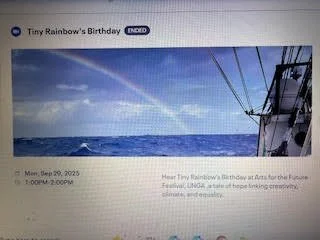
Tiny Rainbow’s Birthday, has had its first public appearance as part of the Arts for the Future Festival aligned with the United Nations 2025.
This children’s book imagined by three women who saw a tiny rainbow being born whilst sailing across the Atlantic. Written by one of these women (me), this story will help children appreciate the natural world, and make it more fair, after all the sky is there to share.

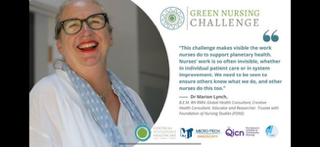
The Nurses Green Challenge concludes in October. Thrilled to be a judge on this national innovation and showing how planetary health is part of nursing too.